Checks before the close
Automated reconciliations, variance thresholds, and exceptions caught while there is still time to fix them.
✓ ClearedThe overview says what Huxley does. This page is for readers who want to know why it works that way: the standard it holds the close to, the reviewer inside it, and the line the AI never crosses.
Not a new title. A new expectation inside finance. Reconciliation that runs before the close. Reporting validated before the board pack. Every exception owned, every step on the record. Fewer heroics at ten at night, more workflows the business can rely on. That shift is the whole reason Huxley exists.
Automated reconciliations, variance thresholds, and exceptions caught while there is still time to fix them.
✓ ClearedTie-outs, policy and disclosure checks, and one source the pack reads from, so it cannot contradict itself.
✓ ValidatedRanked by impact, each with a named owner and an approval path, and its resolution kept on the record.
✓ ResolvedRole-based access, segregation of duties, and a full audit trail built as the work happens, not reconstructed later.
✓ CapturedMost close packs explain what happened, then wait for questions. Huxley is built to answer the next one, while the decision is still live.
Across the close, from the journal entries to the sign-off itself, Huxley raises the questions a careful reviewer asks first. Each is ranked by what is material, carries the figure behind it, and ends with the fix. Nothing reaches the board that you have not already been challenged on. And because every challenge is asked and answered on the record, the team learns a reviewer’s judgment close by close: the knowledge stops living in one person’s head, and the close stops depending on who happens to be in the chair.
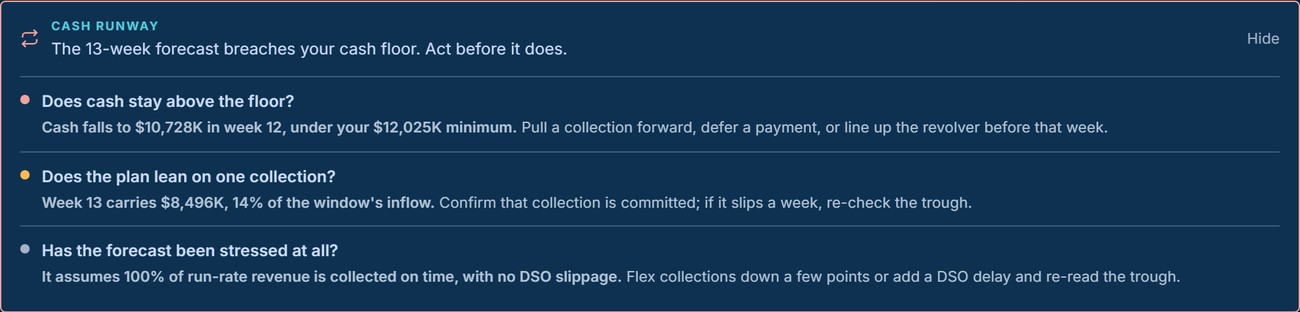
The summary is built Monday from one export, the appendix Wednesday from another, and the data refreshes in between. No one made a mistake, which is what makes it dangerous: the moment a director catches one number that does not tie, every number is suspect. Huxley shuts that door by construction. Every section reads from one close, and the judgment on the numbers stays yours.
Not a deck rebuilt by hand each month. Huxley assembles the pack from the same reconciled close: the recommendation up front, the evidence behind it, and every figure one click from its source. It reads the same at month, quarter or year, and prints clean.
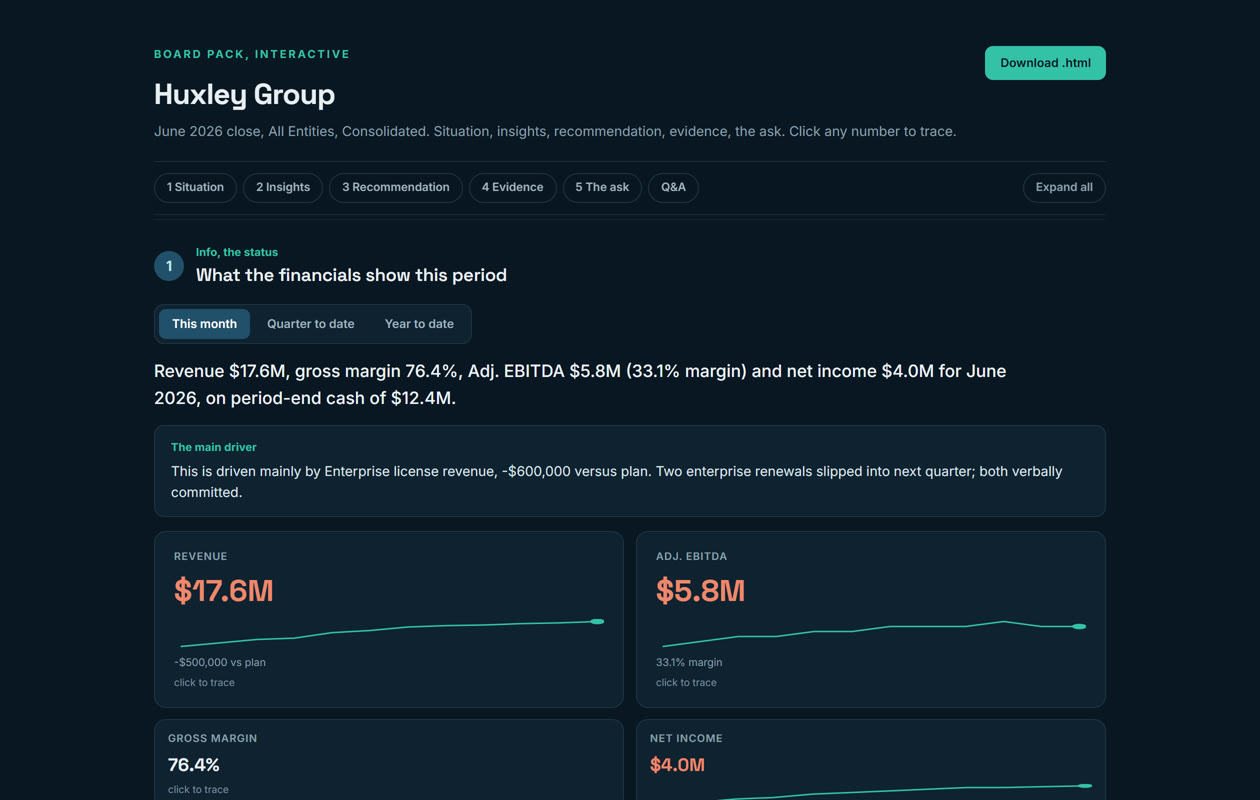
Situation, insights, recommendation, evidence, the ask. The reader gets the point first, then the proof, not a wall of tables.
A trailing-year trend, an EBITDA bridge from plan to actual, and a net-income walk by line. Each reconciles to the dollar.
Flip to the basis a director asks for and the pack follows, without rebuilding a thing. Save it as a clean PDF in a click.
Not “what happened,” which the statements already show. The harder ones, each answered from the close itself, with the working underneath and nothing invented.
Return on capital against the cost of that capital, by entity and for the group. The spread that says whether growth builds value or spends it down.
Forecast accuracy by driver over the trailing year. The lines that keep missing in the same direction, which is a planning gap, not noise.
Named, versioned scenarios. A volume drop or a cost rise, run through to the covenant, reproducible from its inputs every time.
Cash generated and consumed by unit, and what is tied up in receivables and stock, so the group total has faces behind it.
Each project’s committed benefit against what the ledger actually shows. A reported saving the numbers do not back is flagged, never counted.
Headroom on every covenant with the forward test, so a breach is seen while there is still time to act on it.
The fair question every finance leader asks. The honest answer is a governance boundary. On one side, AI gathers context and proposes language. On the other, a person reviews and approves, and every decision is logged so it can be reconstructed for an audit. The judgment stays human, and the trail behind it stays complete.
Huxley flags the material movements, control conflicts, and variances that need an explanation.
AI turns rough notes into clear, board-ready language. It never invents a figure; it only explains the ones already there.
A named person reviews the draft and approves it. Nothing reaches the board pack without a human signing off.
Every approval, edit, and commentary is timestamped and attributed, so the decision can be reconstructed months later.
The bigger the decision, the less you want it automated, and a board-ready close is the highest-stakes work a finance team ships all month. So the AI gets room to surface and draft, and none to decide: it proposes, a named person approves, and every figure traces to its source. That boundary is what makes the result safe to put in front of a board.
There is a second half to that answer. AI in finance is only as useful as the books beneath it: feed it an unreconciled ledger and a chart of accounts grown wild, and it will confidently summarise noise. The discipline a Huxley close enforces, one source, reconciled statements, movements explained at the line, an evidence trail, is exactly the data foundation those tools need. Run a disciplined close now, and every AI tool you adopt later stands on clean ground.
There is a chain that runs through every finance function. Huxley lives in the gap the tools you already own were never built to fill. Most finance AI enters that chain at the top, at the forecast, and trusts the close beneath it; Huxley starts at the close, where the trust is actually built.
The sweet spot is the team that has outgrown spreadsheets and email but is too lean for heavy enterprise close software. That is exactly the band that carries the scrutiny of a big company, an audit, a board, often a PE sponsor, without the infrastructure of one. The expectations are enterprise. The tooling is a spreadsheet. That mismatch is where a small undetected error becomes a year-end surprise. Huxley closes that gap.
I spent ten years in the auditor’s chair, and I was handed a spreadsheet with no story behind it.
I would walk into companies everyone believed were well run, and at audit time all I had was that spreadsheet. No explanation, nothing I could use. So I went back to the client, again and again, looking for the reasoning behind the numbers.
Then I sat on the other side of the table. A Big Four audit foundation, then twenty years as a CFO across public-company, PE-backed, and family-owned businesses. I did not just ask for better reporting, I built it, architecting the BI and data platforms myself, to the point where external auditors trusted my model over the ERP.
The lesson from both chairs was the same. I had sat in meetings where a controller closed the month cleanly, every figure right, and still lost the room to blank stares. The work gets done, it just never gets communicated, and that costs finance the trust it has earned. Huxley is that knowledge built into a tool. I named it after my son. I built it because I have watched too many good finance people miss bedtime while the close ran at ten at night. Better documentation is about trust, and it is about finance teams getting their evenings back.

No, it equips them. The work and the sign-offs stay with your team. Huxley makes what they do documented and defensible, so the numbers hold up when the owner, the lender, or the auditor asks.
No. AI drafts the wording and flags what needs a second look; a named person reviews and approves every figure before it moves. The judgment stays human, and the record proves who decided what.
Yours. Every number traces back to your own source, and you can export the full record whenever you want. Huxley documents your close; it is not a system of record that owns it.
Your data is never used to train any model. The AI sees your numbers only to draft wording about them, inside your close; nothing leaves the record. The numbers stay yours, they trace to your own source, and you can export the full record at any time.
A short, honest read on how documented and defensible your month-end is right now, and the few things that would move it most.